
Key points for PLC-controlled assembly lines
Select PLC by function: list actuators/sensors per station, add 20 % I/O spare, ensure scan ≤ 5 ms for ≤ 1 s takt, pick EtherCAT/Profinet if > 30 m or MES link, choose relay/transistor outputs by load, verify special modules early. Program in four layers: SFC flow, FC stations, FB devices, independent safety; double-interlock every output, timeout cylinders, position+time check conveyors, stop upstream only on fault, demand Quality-OK before release, keep data retentive. Split fast/slow tasks, queue pallets for parallel stations, commission single-step, E-stop, sensor-loss and 120 % takt tests.
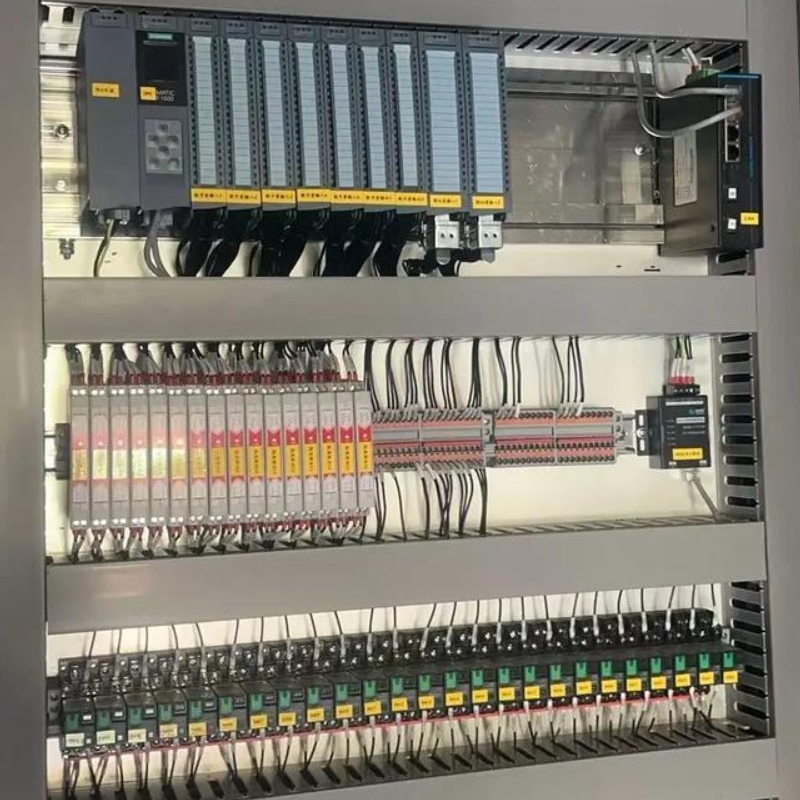
Key Points for PLC-Controlled Assembly Lines
A detailed, generic guide on how to select a PLC and design its program according to the functions of an assembly conveyor.
- Hardware Selection – 7 Steps, Function First
(Valid for any brand; do not change the order)
1.1 Translate the process into an “Action List”
- Count how many stations must be inter-locked
- List every actuator (cylinder, servo, VFD, robot) and every sensor (photo, prox, pressure, vision OK/NG) per station
- Note special modules (weighing, temperature, barcode, vision, RFID)
These numbers decide I/O count and field-bus type later [5, 12]
1.2 Count I/O and add spare
Digital In = sensor count × 1.2
Digital Out = actuator count × 1.2
Analog In/Out = 1-2 per station as a rule of thumb
High-speed inputs for encoders or color marks ≥ 50 kHz
Add 10 % spare on top of the above [14]
1.3 Choose CPU – scan time first, memory second
If takt ≤ 1 s, keep scan ≤ 5 ms
Estimate program size: 100 steps per station × number of stations × 2 (fault & inter-lock) × 1.5 safety factor
Memory = steps × 5 B with 30 % free left [11]
1.4 Choose field-bus – driven by distance
< 30 m single rack: local I/O enough
30 m or > 4 remote drops: use EtherCAT, Profinet, CC-Link IE, etc.
If MES/SCADA connection is required, CPU must supply OPC-UA or MQTT [6, 13]
1.5 Choose output type – driven by actuator
Relay: high-current contactors or 24 V/220 V solenoids, life 1 M ops
Transistor: DC solenoids, servo pulses, < 1 ms response
Triac: AC power-regulation, heaters [14]
1.6 List special modules once
High-speed counter (color mark, encoder), weighing module, vision trigger, temperature PID, safety module (Cat. 3 / PLe)
Confirm the PLC family can host them before you freeze the model [11]
1.7 TCO check – not only hardware price
Add software licence, bus cables, start-up training, future expansion racks
Check team skill – a ladder-only crew will hate a high-end IEC-61131-3 ST-only platform [6]
- Software Design – 4-Layer Skeleton + 6 Universal Rules
(Works for any brand or process)
2.1 Draw the 4-layer skeleton
Layer 1 – Flow (SFC): Power-on → Home → Auto-cycle → Stop → E-stop
Layer 2 – Station (FC): one sub-routine per station; entry = previous done + local free + no fault
Layer 3 – Device (FB): cylinder, servo, VFD, robot each wrapped in an FB exposing only Start/Stop/Fault pins
Layer 4 – Safety (FBD): E-stop, light curtain, gate, two-hand button – highest priority, independent task [10, 13]
2.2 Six universal rules
- Every output gets a double inter-lock inside its FB – software condition AND hardware feedback
- Give every cylinder an “action-timeout” timer; 2 s overrun → fault & stop
- Conveyor uses “position + time” double check – limit switch + timer to detect a jammed pallet [5]
- Any station fault stops only upstream, not downstream, to avoid scrap
- Critical stations (press-fit, weld, screw) must receive a Quality-OK signal before release; otherwise mark NG and divert
- Keep timers, counters and HMI set-points in retentive memory so they survive power-loss [8]
2.3 Takt-time optimisation tricks
- Split scan tasks – 2 ms fast task (servo pulses, safety) and 10 ms slow task (HMI, reporting)
- When stations run in parallel, buffer pallet IDs in a FIFO queue; fill every empty slot to remove idle time [10]
- For long tasks (servo tighten, robot transfer) use step-number + interrupt so PLC scan never stalls
2.4 Commissioning checklist (tick when done)
□ Single-step / single-cycle / dry-run modes all OK
□ Random E-stop at three places – all outputs OFF within 500 ms
□ Pull any sensor – HMI shows “XXX lost” within 1 s
□ Run at 120 % takt for 2 h – CPU scan still < 5 ms
□ 10 power-cycle tests – production data kept, queue not corrupted
One-sentence wrap-up
Selection: “specials first, generics later” – lock bus, high-speed, analog, safety, then pick CPU by I/O count
Programming: “skeleton first, details later” – SFC for flow, FB for devices, double inter-lock for safety, takt & queue for throughput
Follow these two parts and any assembly-line PLC system will be right the first time, easy to expand, and painless to maintain.